
An external gear pump is a positive displacement pump designed to move fluids by using two meshing gears. It is valued for its simple construction, steady fluid transfer, and ability to work across many industrial duties.
The right pump depends on the fluid, pressure, viscosity, temperature, and required flow rate. Understanding these factors helps engineers choose a suitable design instead of selecting a pump based only on capacity.
Delta PD Pumps manufacture external gear pumps in low- and high-pressure ranges. Their DG Series is designed for duties such as liquid transfer and booster applications.
What Is an External Gear Pump?
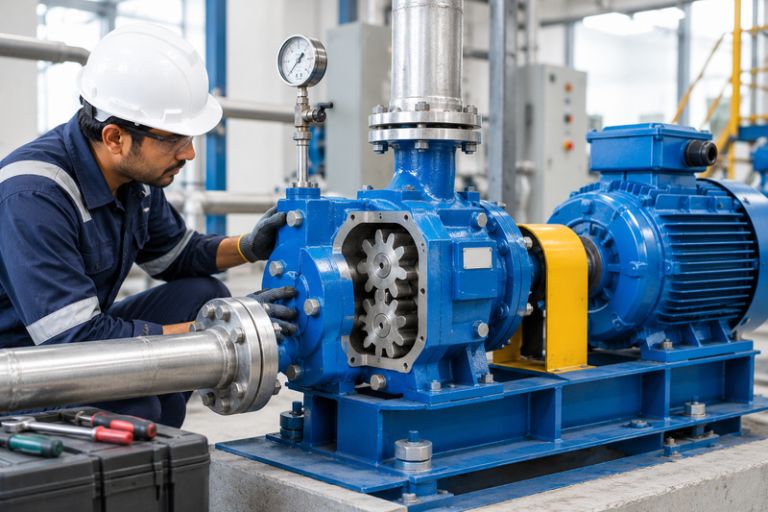
An external gear pump uses two identical gears that rotate against each other. One gear is connected to the motor and drives the second gear. Each gear is supported by a shaft and bearings.
The pump moves fluid through a simple displacement process. As the gears move out of mesh, the space at the inlet increases. This draws fluid into the pump. The fluid then fills the spaces between the gear teeth and casing.
As the gears continue to rotate, they carry the fluid around the casing. The fluid does not pass between the two gears. When the teeth come back into mesh, the fluid is pushed towards the outlet.
This basic design makes the gear pump external arrangement useful for many transfer duties.
How Does an External Gear Pump Work?
The working process can be understood in four simple steps:
- Fluid enters the inlet: The gears move out of mesh and create an expanding volume.
- Fluid fills the cavities: Fluid enters the spaces between the gear teeth and casing.
- Fluid moves around the casing: The rotating gears carry the fluid towards the outlet.
- Fluid leaves under pressure: The gears mesh again and force the fluid through the discharge port.
This process repeats with every rotation. Since the pump delivers a fixed volume per rotation, flow can be controlled by changing the pump speed, within the operating limits of the selected model.
The gear pump external design also uses only two main rotating parts. Delta lists four bearings, a single gland construction, and self-priming as key features of its DG Series.
What Are the Main External Gear Pump Advantages?
The external gear pump advantages come mainly from its straightforward design. It has fewer main moving components than some other pump types, which can simplify operation and servicing.
Key benefits include:
- Simple gear-based construction
- Positive displacement operation
- Self-priming capability
- Compact arrangement
- Support for liquid transfer duties
- Availability in low- and high-pressure designs
- Suitable options for different viscosity ranges
- Four-bearing support for the gears
The external gear pump advantages can be especially useful in industrial systems where reliable fluid transfer and straightforward pump construction are important.
Delta also states that its external gear pumps have economical operating characteristics, including lower power consumption than conventional pumps in suitable applications.
Where Are External Gear Pumps Used?
An external gear pump can be used in different industrial systems depending on its pressure, viscosity, material, and flow requirements.
Typical applications include:
| Industry Or Duty | Common Application |
| Oil and gas | Oil and fluid transfer |
| Power plants | Lubrication and oil transfer |
| Marine | Fuel and lubricating oil transfer |
| Chemical processing | Process fluid transfer |
| Industrial systems | Booster applications |
| General manufacturing | Liquid transfer |
Delta lists sectors such as power plants, oil refineries, marine and navy, chemical processing, food processing, and other industries among the areas it serves.
A suitable external gear pump should always be selected according to the actual fluid and operating conditions. A pump that works well for one application may not be suitable for another.
Can An External Gear Pump Handle High Pressure?
Selected models can be designed for high-pressure duties. Delta’s DG Series includes a low-pressure range and a high-pressure range.
The DGLP Series is listed with a maximum capacity of 1,000 LPM, pressure up to 12 bar, and viscosity up to 100,000 cSt. The DGHP Series is listed with a maximum capacity of 225 LPM, pressure up to 250 bar, and viscosity up to 1,000 cSt.
These figures show why pump selection should be based on the complete operating requirement. Capacity, pressure, viscosity, speed, and construction materials all need to be considered together.
Is An External Gear Hydraulic Pump Suitable for Every System?
An external gear hydraulic pump can be useful in hydraulic fluid power systems, but it should not be treated as a universal solution.
Before selecting one, engineers should check:
- Required operating pressure
- Fluid viscosity
- Operating temperature
- Required flow rate
- Fluid compatibility
- Pump speed
- Seal requirements
- Material of construction
- Duty cycle
The external gear hydraulic pump must also be matched to the hydraulic system’s pressure and flow requirements. Correct sizing helps reduce unnecessary wear and supports reliable operation.
How Do External and Internal Gear Pumps Differ?
An external gear design uses two external gears that mesh with each other. An internal gear design uses a gear-within-gear arrangement, with both gears rotating in the same direction.
The internal gear pump working principle creates a smooth flow with low pulsation, noise, and vibration. It can also handle a wide range of viscosities.
By comparison, an external gear design is often considered when the application needs a simple construction, liquid transfer, or a suitable high-pressure configuration.
The internal gear pump working principle is therefore different from the operating method used in an external gear design. The choice should depend on the process rather than the pump name alone.
Choose The Right Pump for the Application
An external gear pump can be a practical choice for liquid transfer, booster duties, lubrication systems, and other industrial applications. It’s simple construction, self-priming capability, and range of pressure and viscosity options make it suitable for many process requirements.
The external gear pump advantages become most useful when the pump is correctly matched to the application. An external gear hydraulic pump also needs careful selection based on system pressure, flow, and fluid properties.
Delta PD Pumps offers DG Series external gear pumps in low- and high-pressure ranges. They also provide positive displacement pump solutions for different industrial sectors and applications.
For businesses comparing external gear pump manufacturers, application support, technical experience, pump construction, and after-sales service should all be considered before deciding. Delta PD Pumps can help customers assess their pumping requirements and select a suitable solution.