


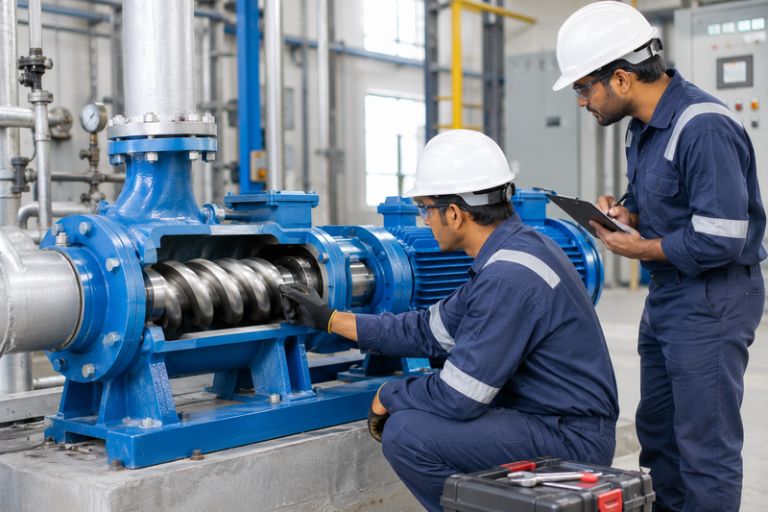
Single screw pumps are positive displacement pumps used to move liquids, slurries and difficult fluids at a controlled rate. They are useful where the fluid may have high viscosity, solids, fibres or air.
Understanding the single screw pump working principle makes pump selection easier. It also helps maintenance teams understand which parts need regular attention.
A progressive cavity pump is another common name for this pump design. It uses a helical rotor and an elastomeric stator to move fluid through sealed cavities. Delta PD Pumps offers D1S series single screw pumps with capacities from 5 to 2,700 LPM and differential pressure up to 24 bar.
What Is a Single Screw Pump?
A single screw pump is a positive displacement pump with two main pumping elements: a rotor and a stator.
The rotor is a single helical screw. It rotates inside a double-threaded stator. The rotor turns eccentrically and creates sealed cavities between the two parts.
These cavities carry fluid from the suction side to the discharge side.
A progressive cavity pump can handle many fluid types. These include low-viscosity liquids, thick fluids, slurries, fluids with fibres and liquids containing solids.
How Does a Single Screw Pump Work?
The process starts when the rotor begins to rotate inside the stator. This creates a series of sealed cavities. These cavities move from the suction side towards the discharge side.
The basic process is:
- Fluid enters through the suction inlet.
- The rotating rotor creates sealed cavities.
- Fluid fills these cavities.
- The cavities move along the pump.
- Fluid reaches the discharge side.
- The cavities continue to fill and empty as the rotor turns.
This explains the single screw pump working principle. The cavities maintain their basic volume while moving, which helps produce a steady flow. The design also creates relatively low fluid velocity and limited agitation.
What Are the Main Screw Pump Parts?
Knowing the screw pump parts and function helps operators identify wear and plan maintenance.
| Pump Part | Main Function |
| Rotor | Rotates inside the stator and moves the fluid |
| Stator | Forms sealed cavities around the rotor |
| Casing | Holds and protects the pumping elements |
| Shaft | Transfers rotation to the rotor |
| Joints | Connect the drive shaft to the rotor |
| Seal | Helps prevent fluid leakage |
| Drive Unit | Provides power for pump rotation |
The rotor and stator are the main working parts. Their condition directly affects pump performance.
The screw pump parts and function can vary slightly between designs. Material selection also depends on the fluid and operating conditions.
What Are the Advantages of Single Screw Pumps?
There are several single screw pump advantages for industrial fluid handling.
- Steady Fluid Movement
A progressive cavity pump creates a continuous movement of fluid through its cavities. This can help reduce sudden changes in flow.
- Handles Difficult Fluids
One major single screw pump advantage is its ability to handle fluids that may be abrasive, shear-sensitive, viscous or contain solids.
- Wide Viscosity Range
Delta’s D1S range is specified for fluids from 1 to 100,000 cP, depending on the selected configuration and operating conditions.
- Flexible Drive Options
The pump can use direct motor drives, gearboxes, V-belt drives or variable speed drives. Special drive arrangements can also be used for certain applications.
These features make single screw pumps suitable for many industrial processes.
Where Are Single Screw Pumps Used?
A single screw pump can be used in industries where conventional pumping methods may struggle with thick or solid-containing fluids.
Common applications include:
- Sewage and wastewater handling
- Sludge transfer
- Slurry pumping
- Chemical processing
- Food processing
- Paint handling
- Fertilizer processing
- Cement applications
- Rubber processing
- Industrial fluid transfer
Delta also lists untreated sewage, filter press duties, oil-water separation, sludge and dewatered sludge among relevant applications.
The single screw pump working principle makes the design useful for controlled movement of these materials.
What Does Single Screw Pump Maintenance Involve?
Regular single screw pump maintenance can help detect wear before it affects production.
A practical single screw pump maintenance guide should cover the main wear areas and operating conditions.
Check these points regularly:
- Rotor condition
- Stator wear
- Shaft and joint condition
- Seal leakage
- Bearing condition
- Coupling alignment
- Pump pressure
- Flow rate
- Unusual noise or vibration
The screw pump parts and function should be understood before carrying out inspection or replacement work.
A good single screw pump maintenance guide should also follow the manufacturer’s instructions. The required maintenance interval can change with fluid type, speed, pressure and operating conditions.
How Can You Reduce Pump Wear?
Good operating practices can support longer pump life.
Avoid running the pump outside its specified limits. Do not ignore unusual noise, vibration, leakage or changes in flow.
For a progressive cavity pump, the stator needs particular attention because it is made from resilient elastomeric material. Delta offers different elastomer options to suit different applications.
A proper single screw pump maintenance routine should also include checking the pump after long shutdowns. Delta provides service kits, spare parts, commissioning support and maintenance training for its pump range.
Select The Right Pump for the Process
The right pump depends on more than flow rate. Fluid properties and operating conditions should be reviewed before selection.
Consider:
- Fluid viscosity
- Solids content
- Fluid temperature
- Required flow
- Discharge pressure
- Suction conditions
- Material compatibility
- Operating speed
- Seal requirements
Understanding how does a single screw pump work can help engineers make a better selection.
The single screw pump working principle is well suited to applications where controlled movement of challenging fluids is required.
Get Reliable Pump Support For Your Application
Single screw pumps offer controlled fluid movement, wide application flexibility and the ability to handle many difficult fluids. Their performance depends on correct selection, suitable operating conditions and regular maintenance.
A clear single screw pump maintenance guide can help operators monitor critical parts and reduce avoidable downtime. The right single screw pump should always be selected according to the actual process requirements.
Delta PD Pumps offers single screw and other positive displacement pump solutions for industrial applications. They provide different materials, drive arrangements and configurations to suit specific pumping needs.
Businesses can discuss their fluid, capacity, pressure and operating requirements with Delta PD Pumps and request a quote for a suitable solution.