
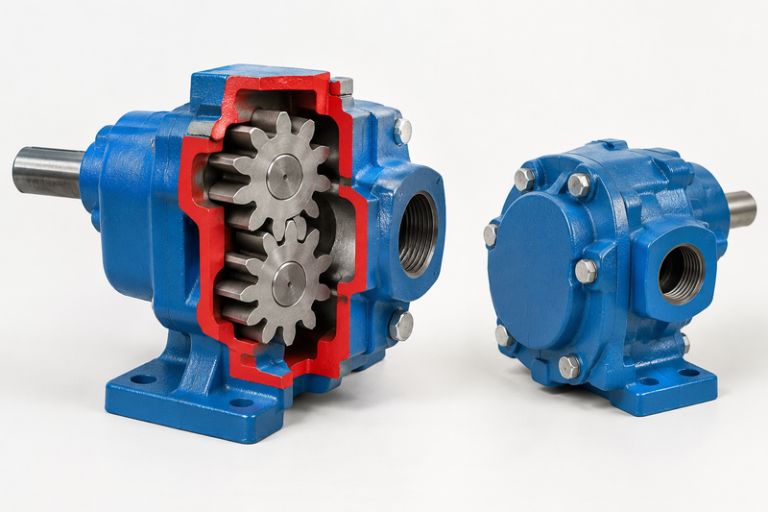
A rotary gear pump is a positive displacement pump used to move liquids at a steady rate. It is often selected for oils, chemicals, fuels, and other fluids that need controlled transfer.
Understanding the rotary gear pump working principle helps industries choose the right pump for their process. The pump type, fluid viscosity, pressure, temperature and flow rate all affect selection.
A rotary gear pump can be used in many industrial systems because of its simple design and reliable fluid transfer. Delta PD Pumps offers rotary trochoidal and external gear pump solutions for different industrial duties. Their rotary trochoidal range covers capacities from 3 to 40 LPM, with pressure up to 7 bar and viscosity up to 500 cSt.
What Is a Rotary Gear Pump?
A rotary gear pump moves liquid through the rotation of gears or rotors inside a close-fitting casing. The rotating parts create spaces that draw fluid into the pump and carry it towards the outlet.
Unlike many dynamic pumps, this type of pump works through positive displacement. A fixed volume of liquid is moved with each rotation.
This makes a rotary gear pump for industrial applications useful where steady liquid transfer is needed.
Common fluids include:
- Mineral oils
- Vegetable oils
- Fuel oils
- Viscous chemicals
- Paints and varnishes
- Printing inks
- Syrups and molasses
- Bitumen and asphalt
The exact fluid must always be matched with the pump design and operating conditions.
How Does a Rotary Gear Pump Work?
The rotary gear pump working principle is based on trapping and moving fluid between rotating elements and the pump casing.
The basic process is:
- The gears or rotors start rotating
- The inlet side develops an expanding volume
- Fluid enters the pump
- Liquid becomes trapped in spaces around the rotating elements
- The rotating parts carry the fluid towards the outlet
- The gears mesh or the pumping spaces reduce in volume
- Fluid is pushed out under pressure
In an external gear design, two gears rotate against each other. The gear teeth carry liquid around the casing rather than through the centre of the meshing gears.
The rotary gear pump working principle can vary with the pump design. However, controlled fluid displacement remains the core function.
What Are the Main Types of Rotary Gear Pumps?
Different gear arrangements are used for different duties. The main types include external gear pumps, internal gear pumps and rotary trochoidal pumps.
- External Gear Pumps
An external gear pump uses two similar gears. One gear is driven by the motor, while the other rotates with it.
The design can support different pressure and capacity ranges. Delta’s DG series, for example, includes low-pressure and high-pressure ranges with different capacity and viscosity limits.
- Internal Gear Pumps
An internal gear pump uses an inner gear and an outer gear. The gears rotate within the pump casing and move fluid from the inlet to the discharge.
The internal gear pump working principle allows the pump to handle many liquids, including fluids with higher viscosity.
The internal gear pump working principle is based on changing spaces between the gears. These spaces fill with liquid at the suction side and reduce as the gears rotate towards discharge.
- Rotary Trochoidal Pumps
Rotary trochoidal pumps use two rotating elements with a gear-within-gear arrangement. The inner rotor sits off-centre, while both rotors rotate.
The design creates changing volumes. Expansion creates suction, while reduction moves the liquid towards discharge. Delta’s DRT and DRTBP series use this principle.
Why Use a Rotary Gear Pump?
The right rotary gear pump benefits can improve fluid handling and system performance.
Key benefits include:
- Smooth and steady flow
- Compact construction
- Self-priming capability in suitable designs
- Good suction performance
- Low noise in selected designs
- Efficient handling of viscous liquids
- Simple mechanical construction
- Reliable operation
A rotary gear pump for high viscosity fluids can be useful because thicker liquids can be moved through controlled positive displacement.
Another rotary gear pump benefit is its ability to support many transfer and lubrication duties. The exact performance depends on fluid properties, speed, pressure and pump construction.
Where Are Rotary Gear Pumps Used?
A rotary gear pump for industrial applications can be found across several sectors.
Typical uses include:
- Oil transfer
- Fuel handling
- Lubrication systems
- Chemical transfer
- Paint and ink transfer
- Barrel unloading
- Bearing lubrication
- Gearbox cooling
- Heating and filtering units
- Machinery pre-lubrication
Delta PD’s rotary trochoidal pumps are listed for transfer, barrel unloading, pressure lubrication, bearing and gearbox cooling, and pumping, heating, cooling and filtering units.
A rotary gear pump for high viscosity fluids is also used for liquids such as oils, bitumen, asphalt, syrups and viscous chemicals.
How To Select the Right Gear Pump
Pump selection should start with the process requirements. A rotary gear pump should not be selected only by flow rate.
Check these factors first:
- Required flow rate
- Operating pressure
- Fluid viscosity
- Fluid temperature
- Fluid compatibility
- Suction conditions
- Required motor speed
- Seal requirements
- Installation space
- Duty cycle
For example, a rotary gear pump for industrial applications may need a different configuration for fuel transfer than for lubrication.
The internal gear pump working principle also makes internal gear designs worth considering when the process involves specific viscosity and transfer requirements.
Choose The Right Pump for Reliable Fluid Transfer
A rotary gear pump can provide controlled and steady liquid transfer across many industrial processes. Its design makes it suitable for oils, fuels, chemicals and other fluids where positive displacement is useful.
The right rotary gear pump benefits depend on correct sizing and application matching. A rotary gear pump for high viscosity fluids should be selected according to viscosity, temperature, pressure and speed requirements.
Delta PD Pumps has supplied positive displacement pump solutions since 1968 and offers rotary trochoidal, internal gear, external gear and screw pump options. They also provide customized pumping systems based on customer requirements.
For businesses comparing rotary gear pump manufacturers, they can discuss the application, operating conditions and required specifications with Delta PD Pumps and request a quote for a suitable pumping solution.