
Choosing the right positive displacement pump depends on the fluid, pressure, viscosity, temperature, and duty cycle. Two common options are internal and external gear pumps. Both use rotating gears to move fluid, but their construction and operating methods are different.
Understanding these differences helps engineers select a pump that matches the process. An internal gear pump can be a strong choice for viscous fluids and applications that need smooth flow. An external gear pump may suit applications that need higher pressure or a more compact gear arrangement.
Delta PD Pumps manufactures both pump types for different industrial duties. Their product range covers applications across power, chemical, food processing, oil and gas, marine, and other industries.
How Do Internal and External Gear Pumps Work?
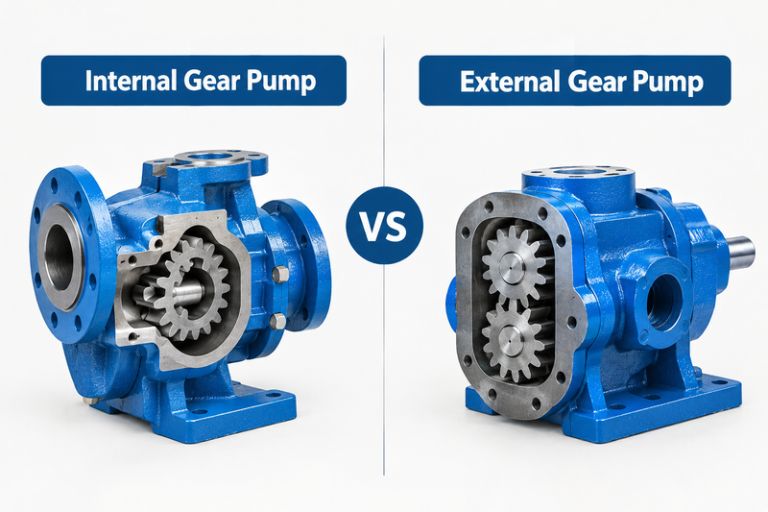
The internal gear pump working principle is based on two gears that rotate in the same direction. The main gear is connected to the drive shaft. A smaller idler gear sits on an eccentric pin.
As the gears move out of mesh, a partial vacuum is created at the inlet. This draws fluid into the pump. The fluid fills the spaces between the gear teeth and casing. The rotating gears then carry the fluid towards the delivery port.
This internal gear pump working method produces a smooth and steady flow. It also results in low pulsation, noise, and vibration.
An external gear pump uses two identical gears that rotate against each other. One gear is driven by the motor, while it drives the second gear. Fluid enters as the gears move out of mesh. It is then carried around the casing in the spaces between the teeth and casing before being forced through the outlet.
A Quick Comparison
| Feature | Internal Gear Pump | External Gear Pump |
| Gear arrangement | Gear within gear | Two external gears |
| Gear rotation | Same direction | Opposite directions at the mesh |
| Flow | Smooth and steady | Steady positive displacement flow |
| Viscosity handling | Wide viscosity range | Depends on model and design |
| Typical use | Viscous and process fluids | Transfer and booster duties |
| Maintenance | Easy access in suitable designs | Simple gear arrangement |
| Pressure range | Application dependent | High-pressure models available |
The internal gear pump working design is particularly useful where smooth handling and wide viscosity capability are important. An external gear pump can be useful when pressure capability and simple construction are key selection factors.
When Is an Internal Gear Pump the Better Choice?
The main benefit of an internal gear design is its ability to handle a broad range of viscosities. Delta lists viscosity handling up to 100,000 cSt for its DIG series. The same range is listed with capacities up to 800 LPM, pressure up to 14 kg/cm², and temperatures up to 200°C.
An internal gear pump may be considered when the process involves:
- High-viscosity fluids
- Heated process fluids
- Oils and lubricating fluids
- Chemical products
- Food processing fluids
- Applications that need low pulsation
- Fluids that require gentle transfer
The design also supports heating and cooling jackets in suitable configurations. This can help maintain the required fluid temperature during pumping.
For these reasons, an internal gear pump is often considered for process pumping where viscosity and temperature can change the pumping conditions.
When Does an External Gear Pump Make More Sense?
An external gear pump has two identical gears supported by shafts and bearings. Its straightforward design makes it suitable for many fluid transfer duties. Delta offers low-pressure and high-pressure versions within its DG series.
The listed specifications show that the low-pressure series can reach up to 1,000 LPM and 12 bars. The high-pressure series can reach up to 225 LPM and 250 bars, with viscosity limits depending on the model.
An external gear pump may be suitable for:
- Liquid transfer
- Booster applications
- Hydraulic fluid duties
- Oil transfer
- Industrial lubrication systems
- Applications requiring higher pressure
An external gear oil pump can therefore be considered when oil transfer or lubrication is the main duty. The final selection should still account for pressure, viscosity, speed, temperature, and material compatibility.
Internal Gear Vs External Gear: What Should You Compare?
The choice should not be based only on the pump name. The process conditions matter more.
When comparing internal gear pumps with an external gear pump, check these factors:
- Fluid viscosity:
Thicker fluids may favour an internal gear design, depending on the required operating conditions.
- Pressure:
Check the required discharge pressure against the selected pump’s rated range.
- Temperature:
Hot fluids may require suitable casing materials, seals, clearances, and heating or cooling arrangements.
- Flow rate:
The required flow should be compared with the pump’s rated capacity at the actual operating speed.
- Fluid properties:
Consider lubrication value, chemical compatibility, abrasiveness, and sensitivity to shear.
- Installation:
Available space, mounting arrangement, drive configuration, and maintenance access can also influence the selection.
This approach makes it easier to choose between an internal gear pump and an external gear pump based on actual process needs rather than general assumptions.
What Should You Look for in Pump Manufacturers?
Selecting the right supplier is as important as selecting the right pump. Experienced internal gear pump manufacturers should be able to understand the application before recommending a design.
Look for support in areas such as:
- Pump sizing and selection
- Material selection
- Seal selection
- Drive and speed requirements
- Installation guidance
- Spare parts
- Maintenance support
- Application-specific engineering
The same approach applies when comparing internal gear pump manufacturers for long-term industrial use. A supplier with application knowledge can help match the pump to the process instead of treating every duty in the same way.
Delta PD Pumps has manufactured positive displacement pumps since 1968 and offers internal and external gear pump ranges along with other pump technologies. Their service support includes installation, commissioning, training, field repairs, and spare parts.
Choose The Pump Around Your Process
There is no single pump that is best for every application. An internal gear pump can be a suitable option for viscous fluids, smooth flow, and process duties that require controlled pumping. An external gear pump can be better suited to transfer and booster duties, including applications with higher pressure requirements.
The right internal gear pump working conditions should be reviewed before final selection. An external gear oil pump should also be selected according to the oil properties and operating requirements.
Reliable internal gear pump manufacturers can help evaluate these factors and recommend a suitable configuration. Delta PD Pumps provides different positive displacement pump designs and application support for industrial pumping requirements.
If you need help selecting a pump for your application, request a quote from Delta PD Pumps with your flow rate, pressure, fluid, viscosity, temperature, and operating details.