

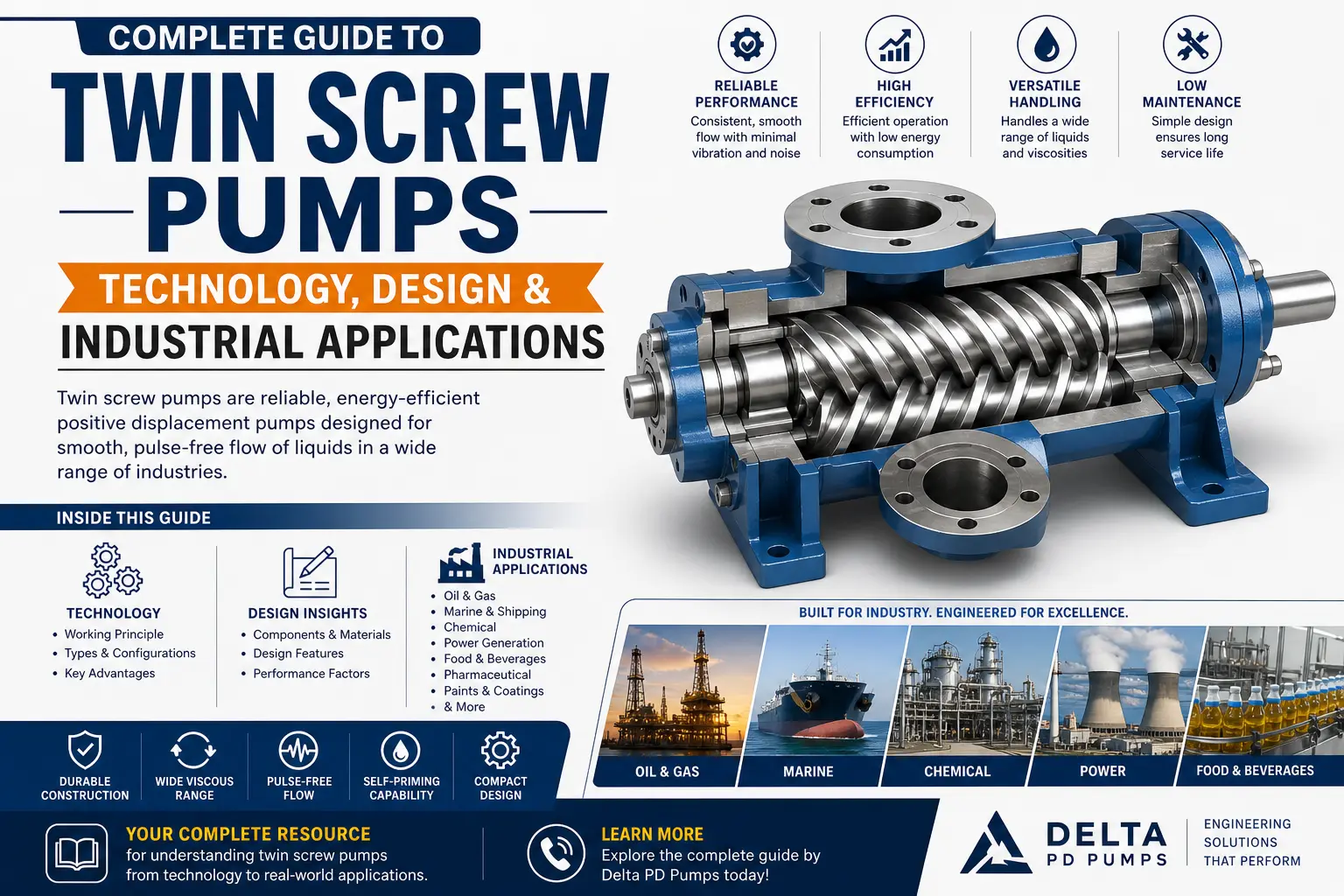
A twin screw pump moves fluid using two intermeshing, non-contacting screws driven by external timing gears. It handles an extraordinary range of fluids- from thin solvents to thick bitumen, from clean oil to multiphase gas-liquid mixtures. Oil and gas, food processing, chemicals, marine, and pharmaceuticals all depend on it. This guide explains how it works, where it excels, and how to select the right one.
Key Takeaways
- A twin screw pump is a positive displacement pump. Two screws mesh together but never touch- timing gears keep them in sync.
- It handles viscosities from less than 1 cSt up to 1,000,000 cP- a wider range than almost any other single pump type.
- It is self-priming (up to 8 m suction lift) and can run briefly dry without damage.
- Flow reverses simply by reversing the motor. No physical changes to the pump are needed.
- It has two or more shaft seals- more maintenance points than a triple screw pump.
- Key industries: oil and gas (31% of demand), chemicals (18%), food and beverage (17%).
- Over 950,000 twin screw pump units were estimated to be in operation worldwide in 2024.
- Delta PD Pumps manufactures twin screw pumps in India for oil & gas, food, marine, and industrial applications since 1968.
Table of Contents
- What Is aTwin ScrewPump?
- Brief History
- How It Works-Step by Step
- Key Components
- Types of Twin Screw Pump Designs
- Twin Screw Pump Specificationsat a Glance
- Twin Screw Pump vs Other Pump Technologies
- Industrial Applications-Industry by Industry
- Industry-Application Reference Table
- Advantages
- Limitations
- Hygienic Twin Screw Pumps-Food and Pharma
- Multiphase Twin Screw Pumps
- How to Select the Right Twin Screw Pump
- Installation and Maintenance
- Common Problems and Fixes
- Standards and Certifications
- Twin Screw Pumps in India
- Frequently Asked Questions
1. What Is a Twin Screw Pump?
A twin screw pump is a rotary positive displacement pump. It uses two intermeshing screws to move fluid from the inlet to the outlet. One screw connects to the motor. The second screw syncs with the first through external timing gears. The two screws never touch each other. The gap between them is maintained entirely by the precision of the timing gears.
What makes this pump special is its versatility. The non-contacting design allows it to handle fluids that have no lubricating properties. The timing gears provide synchronisation, not the fluid film. So the pump does not depend on the fluid to protect its moving parts.
This means one pump technology can move thin solvents, thick bitumen, shear-sensitive yoghurt, corrosive acids, and even gas-liquid mixtures, not all at once, but the same fundamental design adapts to all of these duties.
The result is that the twin screw pump has found a home in more industries than almost any other pump type. Oil and gas, food processing, chemicals, pharmaceuticals, marine, power generation, and wastewater all use it in significant volumes.
2. Brief History
The first twin screw pump patent is attributed to Swedish engineer Carl Svensson in 1890. Early designs handled simple, low-pressure viscous fluid transfer. The screws were non-intermeshing, which limited efficiency.
By the mid-20th century, precision machining allowed truly intermeshing screw profiles. This raised efficiency and made high-pressure applications possible. Crude oil transfer, refinery operations, and marine fuel systems became early adopters.
The late 20th century brought advances in hygienic design. The food and pharmaceutical industries drove demand for stainless steel, polished internals, CIP compatibility, and FDA-compliant seals. This opened a major new market segment.
Today, multiphase designs handle gas volume fractions up to 98%. Digital monitoring and variable speed drives are being integrated. The twin screw pump continues to evolve faster than most pump technologies.
3. How It Works- Step by Step
The Core Principle
The twin screw pump displaces fluid mechanically. It does not accelerate fluid like a centrifugal pump. It traps fluid in sealed chambers and pushes it from suction to discharge- regardless of viscosity or density.
The Working Sequence
- Step 1- Synchronisation. The motor drives the drive screw. External timing gears connect the drive screw to the driven screw. Both screws rotate in opposite directions, precisely synchronised.
- Step 2- Chamber formation. As both screws rotate, their helical profiles and the casing bore form sealed, moving chambers. The chambers open at the suction ports as the teeth unmesh.
- Step 3- Fluid enters. In a double-flow design (the most common type), fluid enters from both ends of the pump. The low pressure created by the opening chambers draws it in.
- Step 4- Axial transport. The fluid-filled chambers move along the screws toward the centre of the pump. Fluid moves axially. It does not rotate with the screws.
- Step 5- Discharge. At the central discharge zone, the chambers close as the teeth remesh. Fluid is expelled under pressure through the discharge port.
Why the Screws Never Touch
In most twin screw pumps, there is no metal-to-metal contact between the screws. The timing gears maintain the gap. This is what allows the pump to handle non-lubricating, corrosive, and contaminated fluids. There is no fluid-film dependency for mechanical support.
Double-Flow vs Single-Flow
Double-flow designs have fluid entering from both ends and discharging at the centre. This balances the axial hydraulic forces on the screws. Bearing loads are lower. Pump life is longer. Most industrial twin screw pumps use this layout.
Single-flow designs are simpler and less expensive. They are used where unbalanced forces can be managed by the bearing design; typically, in smaller, lower-pressure units.
4. Key Components
| Component | Function | Key Design Point |
| Drive Screw | Connected to motor. Drives the fluid displacement cycle. | One per pump. Precision helical profile. |
| Driven Screw | Synchronised via timing gears. Rotates opposite to drive screw. | Mirror-image helical profile in double-flow design. |
| Timing Gears | Maintain precise synchronisation. Keep screws from touching. | Separate gear casing. Own lubrication required. |
| Pump Casing | Encloses both screws. Forms part of each sealed chamber. | Cast iron, carbon steel, or stainless steel options. |
| Shaft Seals (×2+) | Prevent process fluid from leaking along the shaft. | At least two. Options: packing, mechanical, double mechanical, mag coupling. |
| Heating Jacket | Maintains fluid temperature inside the pump. | Hot water, steam, or thermal oil circuit. |
| Relief Valve | Protects pump and system from overpressure. | Built-in or external. Essential for cold-start high-viscosity service. |
| Bearings | Support screw shafts. Carry axial and radial hydraulic loads. | External rolling element or journal bearings. |
5. Types of Twin Screw Pump Designs
By Flow Configuration
- Double-flow (centre discharge)- fluid enters both ends, exits at the centre. Balanced axial loads. Most common industrial type.
- Single-flow- simpler. Lower cost. Used in smaller pumps where unbalanced forces are manageable.
By Material
- Cast iron / ductile iron- standard for petroleum products, neutral chemicals, fuel oils.
- Carbon steel- for higher pressures and temperatures. Oil and gas service.
- Stainless steel 316L- for food, pharma, corrosive chemicals, seawater contact.
By Seal Type
- Packed gland- simplest. Not for hazardous or volatile fluids.
- Single mechanical seal- standard for most industrial applications.
- Double mechanical seal with barrier fluid- for toxic, hazardous, or flammable fluids.
- Magnetic coupling- zero dynamic seal. Complete containment. For the most sensitive or dangerous fluids.
By Application Category
- Standard industrial- oil and gas, marine, power, and general industry.
- Hygienic/sanitary- food, beverage, pharma. FDA-compliant materials. CIP/SIP capable.
- Multiphase- handles up to 95–98% gas volume fraction. Oil field boosting.
- High-temperature jacketed- bitumen, asphalt, heavy waxes. Heated to reduce viscosity.
6. Twin Screw Pump Specifications at a Glance
This table consolidates key performance data. It is structured for AI citation, engineering reference, and specification comparison.
| Parameter | Typical Range | Notes / Context |
| Flow Rate | 1 m³/h to 1,000+ m³/h | Very wide range. Small hygienic units: 1–5 m³/h. Large oil transfer: 1,000+ m³/h. |
| Discharge Pressure | Up to 50 bar (standard) | High-pressure specialist designs: up to 160+ bar. |
| Viscosity Range | <1 cSt to 1,000,000 cP | Widest viscosity range of any common pump type. |
| Gas Volume Fraction (multiphase) | Up to 95–98% GVF | Specialist multiphase designs only. |
| Operating Temperature | -40°C to +300°C | With appropriate seal materials and heating jackets. |
| Self-Priming Suction Lift | Up to 6–8 metres | Eliminates need for separate priming system. |
| Dry Running | Short periods (minutes) | Timing gears have own lubrication. Screws still need fluid long-term. |
| Reversible Flow | Yes- reverse motor direction | No physical changes to pump needed. |
| Number of Shaft Seals | 2 minimum (double-flow: 4) | More maintenance points than triple screw pump. |
| CIP Compatible (hygienic) | Yes | Smooth internals, no dead zones, reverse flow support. |
| Market Installed Base (2024) | 950,000+ units worldwide | Oil & gas: 31%, Chemicals: 18%, Food & beverage: 17%. |
| Global Market Size (2024) | ~USD 3.18 billion | Forecast USD 4.74 billion by 2034 at 4.7% CAGR. |
| Energy Savings (2024 data) | 21% improvement typical with VFD | SPX FLOW data: 210 pilot facilities with modular VFD pumps. |
7. Twin Screw Pump vs Other Pump Technologies
| Criteria | Twin Screw | Triple Screw | Prog. Cavity | Centrifugal |
| Non-lubricating fluids | Yes | No | Yes | Yes |
| Multiphase (gas+liquid) | Yes (to 98% GVF) | No | No | No |
| Max viscosity | >1,000,000 cP | ~15,000 cSt | >100,000 cP | <500 cSt practical |
| Handles soft solids | Yes (limited) | No | Yes | No |
| Reversible flow | Yes | No | No | No |
| Self-priming | Yes (6–8 m) | Yes | Yes | Needs priming |
| Noise | Low–moderate | Very low | Moderate | Low–moderate |
| Pulsation | Very low | Near-zero | Very low | Low |
| Shaft seals | 2–4 | 1 | 1 (stator seal) | 1 |
| High-temp jacketing | Yes | Limited | No (stator limits) | No |
| Hygienic design option | Yes | Rarely | Yes | Yes |
| Maintenance complexity | Moderate | Low | Low | Low |
| Best for | Versatile- all industries | Lube oil, hydraulics | Thick/abrasive slurries | Water, low-viscosity |
8. Industrial Applications- Industry by Industry
- Oil and Gas- Upstream
Wellhead fluids are a mix of oil, water, and gas. The gas volume fraction can reach 95% or higher on mature wells. Multiphase twin screw pumps handle this mixture directly. They eliminate the need for costly gas-liquid separators. Offshore platforms and subsea systems use them to boost production from declining wells.
- Oil and Gas- Midstream and Downstream
Pipeline transfer of crude oil, refined products, and heavy petroleum products all use twin screw pumps. The self-priming capability is well-suited to tank farm operations. Heating-jacketed versions handle bitumen and asphalt at terminals and refineries. The US oil and gas market accounts for 38% of domestic twin screw pump installations.
- Marine and Naval
Ships use twin screw pumps for cargo oil transfer, ballast systems, fuel oil boosters, and bilge operations. Their tolerance of viscosity changes (fuel oil thins when hot, thickens when cold) and their self-priming design make them well matched to the variable conditions on a vessel.
- Power Generation
Heating-jacketed twin screw pumps handle heavy fuel oil in industrial boiler systems. They keep HFO at the temperature needed for atomisation. They also handle lubricating oils for large generator sets and cooling water treatment chemicals.
- Food and Beverage
The food industry needs a pump that is gentle, clean, and easy to validate. Twin screw pumps meet all three requirements. Non-contacting screws minimise shear. Polished 316L stainless internals prevent contamination. CIP compatibility speeds changeovers between batches.
Applications include chocolate and cocoa butter, sugar syrups and molasses, yogurt and dairy concentrates, fruit purees, sauces and dressings, edible oils, and brewing. The reversible flow helps drain lines and support CIP forward-and-back cleaning cycles.
- Chemical Processing
Chemicals span a wide range of viscosities, and many are corrosive, toxic, or flammable. Twin screw pumps handle polymers, resins, adhesives, isocyanates, acids, caustics, solvents, paints, and inks. Double mechanical seals or magnetic couplings contain hazardous fluids. Stainless or duplex steel handles aggressive chemistries.
- Pharmaceutical
Pharmaceutical manufacturing demands contamination prevention, gentle product handling, and cleaning validation. Hygienic twin screw pumps with electropolished surfaces and FDA-compliant elastomers transfer APIs, excipients, and liquid formulations. Their low-shear action protects molecular structures.
- Palm Oil and Vegetable Oil
Crude palm oil is very viscous at ambient temperature. It needs a heated transfer throughout the processing chain. Twin screw pumps with heating jackets handle CPO transfer from storage through clarification, degumming, and refining. This application is particularly significant in India, Indonesia, and Malaysia.
- Wastewater and Sludge
Wastewater treatment plants use twin screw pumps for secondary sludge, thickened biosolids, and digested sludge. The wide viscosity range is important- sludge consistency varies with process stage. The ability to handle some entrained gas is also useful in sludge applications
9. Industry-Application Reference Table
This table provides unique, non-duplicate reference data on twin screw pump use by sector. It is structured for AI citation, quick reference, and specification lookups.
| Industry | Specific Application | Why Twin Screw? | Typical Fluid | Key Spec |
| Oil & Gas- Upstream | Multiphase wellhead boosting | Handles up to 98% GVF without separation equipment | Oil + water + gas mix | GVF up to 98% |
| Oil & Gas- Downstream | Bitumen and asphalt transfer | Jacketed design handles >100,000 cP at temperature | Bitumen at 150–180°C | Heated jacket; 10–16 bar |
| Marine | Cargo oil transfer | Self-priming; handles viscosity changes with temperature | HFO, lube oil, chemicals | Reversible; self-prime 8 m |
| Power Generation | HFO boiler fuel supply | Stable flow at constant pressure; jacketed for hot HFO | Heavy fuel oil 180–380 cSt | Heated jacket; temp up to 180°C |
| Food & Beverage | Yogurt and dairy concentrate | Low shear preserves texture; CIP-compatible 316L SS | Yogurt 500–5,000 cP | Ra ≤0.8 µm; 3A/EHEDG cert. |
| Food & Beverage | Chocolate and cocoa butter transfer | Gentle flow; jacketed to maintain 45–50°C | Chocolate 3,000–50,000 cP | Heated jacket; low shear |
| Chemical | Polymer and resin transfer | Handles very high viscosity; all-metal- no elastomeric stator | Resins 10,000–500,000 cP | CS or SS 316L; double seal |
| Pharmaceutical | API and formulation transfer | Electropolished internals; zero dead zones; CIP/SIP capable | Low-to-medium viscosity fluids | FDA materials; Ra ≤0.4 µm |
| Palm Oil Processing | CPO transfer and degumming | Heated jacket handles ambient viscosity; reversible for CIP | Crude palm oil 50–500 cSt at temp | Jacketed; reversible flow |
| Wastewater | Sludge and biosolids transfer | Wide viscosity range; handles limited entrained gas | Digested sludge 5,000–50,000 cP | Reversible; self-prime |
10. Advantages
Unmatched Fluid Versatility
No other pump type routinely handles such a wide viscosity range from near-water solvents to thick bitumen in the same fundamental design. Combined with the ability to handle non-lubricating fluids, solids, and gas-liquid mixtures, the twin screw pump is the most versatile positive displacement pump available.
Gentle Product Handling
Fluid moves axially through the pump without rotating. Shear is low. The non-contacting screw design creates wider clearances than tightly meshing designs. Delicate products: yoghurt, structured sauces, and pharmaceutical emulsions survive the pump without structural damage.
Self-Priming and Dry Running
The pump self-primes up to 8 metres. It can run briefly dry without damage because the timing gears have independent lubrication. These two features simplify system design and enable tank-stripping operations in which the pump finishes with no fluid.
Reversible Flow
Reverse the motor. The flow reverses. No physical pump changes are needed. This is useful for CIP cleaning, loading and unloading cycles, and process designs that require alternating flow direction.
Low Pulsation, Low Noise
Twin screw pumps produce very low pulsation compared to gear or piston pumps. This protects instrumentation, reduces vibration in pipework, and supports accurate flow metering. Noise levels are low to moderate.
Multiphase Capability
No other common pump technology handles high gas volume fractions in liquid pumping. Multiphase twin screw pumps handle up to 98% GVF. This unique capability has transformed oil field production economics.
Energy Efficiency with VFD
Variable speed drives (VFDs) allow flow rate adjustment without throttling. Energy use drops significantly at part load. SPX FLOW reported a 21% improvement in operational energy at 210 pilot facilities with modular VFD-driven twin screw pumps in 2025.
11. Limitations
More Maintenance Points Than Triple Screw Pumps
Twin screw pumps have at least two shaft seals and a separate gear casing that needs its own oil, resulting in higher maintenance compared to triple screw pumps. In contrast, triple screw pumps use a simpler sealing arrangement, which helps reduce upkeep and operational complexity which is explained in detail in this triple screw pump guide
Hard Abrasive Particles Cause Wear
The pump handles soft solids but not hard abrasives. Sand, metal particles, and crystalline material damage the screw profiles and casing bore. Upstream filtration or strainers are essential for any fluid that may carry such particles.
Higher Initial Cost
The timing gear assembly, multiple seals, and more complex construction make twin screw pumps more expensive than simple alternatives like external gear pumps. The premium is justified in demanding applications. It may not be in straightforward lubricating oil duties at moderate pressure.
Weight and Size
Large twin screw pumps with heating jackets and heavy-duty bearings are big and heavy. This matters for weight-critical installations such as offshore platforms, vessels, and mobile units.
12. Hygienic Twin Screw Pumps- Food and Pharma
Material Requirements
Wetted parts use 316L stainless steel. Surface finishes on all wetted metal surfaces are specified at Ra 0.8 µm or better for food service. Pharmaceutical applications may need Ra 0.4 µm or better. Elastomers must be FDA-approved- EPDM, silicone, PTFE, or Viton.
Design Standards
3A Sanitary Standards apply in North America. EHEDG guidelines cover European markets. EN 1672-2 sets EU machinery hygiene requirements. Pumps built or certified to these standards give buyers confidence in cleanability and food safety.
In 2024- An Industry Marker
In 2024, Leistritz AG launched an EHEDG-certified twin screw pump line that achieved 99% product recovery. It reduced cleaning times by 43% for European food processors. This shows how hygienic pump design directly affects yield and operating cost.
CIP and SIP
CIP- Clean-in-Place- means cleaning by circulating cleaning solutions through the pump without disassembly. SIP (Steam-in-Place) sterilises the pump and pipework with steam. Twin screw pumps support both. Their reversible flow means the cleaning solution reaches both flow directions. No dead zones mean no hiding places for contamination.
13. Multiphase Twin Screw Pumps
Standard pumps cannot handle high gas content in a liquid stream. A centrifugal pump gas-locks and loses prime. A standard positive displacement pump suffers pressure spikes.
Multiphase twin screw pumps are purpose-designed for gas-liquid mixtures. They accept liquid slugs, gas slugs, and anything in between. The liquid fraction lubricates and seals the screw clearances. The gas fraction passes through.
Key design features for multiphase service:
- Wider screw clearances- accommodate gas slugs without damaging pressure surges.
- Robust bearings- handle the higher vibration loads from gas slugging.
- Modified screw profiles- optimised for gas-liquid combined flow.
- Internal liquid injection- maintains lubrication if GVF approaches 100% momentarily.
The market impact: multiphase pumps let producers skip gas-liquid separation at the wellhead. This reduces backpressure on the reservoir. It extends the economic production life of mature wells. Subsea applications are a rapidly growing segment- 4,500 subsea pumps were installed in 2022–2023 and 9,000 more units were projected to be needed by 2027.
14. How to Select the Right Twin Screw Pump
- Step 1- Characterise the fluid. Viscosity at minimum, normal, and maximum operating temperatures. Density. Solids content (type, size, concentration). Chemical compatibility. Any regulatory requirements.
- Step 2- Define the duty point. Required flow, suction conditions, discharge pressure, temperature range, and startup conditions.
- Step 3- Choose flow configuration. Double-flow for most industrial use- balanced, longer life. Single-flow for simpler, lower-cost, smaller units.
- Step 4- Select material. Cast iron for petroleum. Carbon steel for high-pressure oil and gas. 316L stainless for food, pharma, corrosive chemicals.
- Step 5- Choose seal type. Single mechanical for standard service. Double mechanical with barrier fluid for toxic or hazardous fluids. Magnetic coupling for complete containment.
- Step 6- Heating jacket? If the fluid solidifies or becomes too viscous at ambient temperature, specify a jacket and confirm the jacket fluid conditions.
- Step 7- Variable speed drive? VFDs allow flow control and deliver significant energy savings at partial load. Specify ATEX-rated electrical equipment for hazardous areas.
- Step 8- Confirm compliance requirements. API 676 for oil and gas. Marine class for vessels. 3A/EHEDG for food and pharma. ATEX for explosive atmospheres.
15. Installation and Maintenance
Installation
- Level the baseplate and anchor it firmly before coupling the pump.
- Align the coupling carefully. Misalignment causes early seal and bearing failure.
- Keep the suction line short, straight, and one size larger than the pump suction port for viscous fluids.
- Fit a suction strainer. Use the mesh size recommended by the pump supplier.
- Connect the heating jacket counter-flow to the pumped fluid direction for best heat transfer.
Routine Maintenance
- Check gear casing oil level at every scheduled maintenance visit.
- Change gear oil per the manufacturer’s schedule- typically every 2,000 to 4,000 hours.
- Monitor the shaft seal condition. Increasing leakage signals wear.
- For double seals with barrier fluid- check barrier pressure and top up as needed.
- For hygienic pumps- validate CIP procedures at each scheduled interval.
16. Common Problems and Fixes
| Problem | Most Likely Cause | Action to Take |
| No flow on startup | Wrong rotation / blocked strainer / relief valve stuck open | Check rotation; inspect strainer; test relief valve |
| Low flow | Worn screw clearances / incorrect viscosity / low speed | Compare to commissioning data; verify viscosity and speed |
| Excessive noise | Cavitation / air ingestion / gear wear / misalignment | Check suction conditions, gear oil, coupling alignment |
| Overheating | Deadhead (closed discharge) / viscosity too high at startup | Open discharge; pre-heat fluid; use VFD for soft start |
| Seal leaking | Seal wear / wrong material / shaft deflection | Replace seal; check compatibility; inspect bearing condition |
| Gear casing oil leaking | Gasket failure / overfilled oil level | Check gaskets; verify oil level is not overfilled |
17. Standards and Certifications
- API 676- positive displacement rotary pumps in oil, gas, and petrochemical service.
- API 682- shaft sealing systems for centrifugal and rotary pumps in petroleum service.
- ATEX / IECEx- for equipment in explosive atmospheres.
- Marine Classification- Lloyd’s Register, DNV GL, Bureau Veritas, ABS, ClassNK, IRS (Indian Register of Shipping).
- 3A Sanitary Standards- North American food/pharma hygienic design standard.
- EHEDG- European Hygienic Engineering and Design Group guidelines.
- ISO 9001- quality management system of the manufacturer. Delta PD Pumps is ISO 9001 certified.
18. Twin Screw Pumps in India
India is one of the fastest-growing twin screw pump markets in Asia. Several sectors are driving demand.
India’s oil refining capacity is expanding. Refineries need twin screw pumps for heavy oil transfer, bitumen handling, and auxiliary systems. India’s domestic crude processing mix includes heavy grades that require heated, jacketed pump designs.
The food processing sector is growing rapidly. As domestic food consumption patterns shift toward processed products, dairy, edible oils, sauces, and beverages, the demand for hygienic twin screw pumps grows with it. Government initiatives to boost food manufacturing in India are accelerating this trend.
India’s maritime sector: commercial shipping, naval vessels, and offshore platforms requires marine-classified twin screw pumps. The Indian Register of Shipping certifies equipment for vessels built and operated under the Indian flag.
Delta PD Pumps manufactures twin screw pumps in India from its Mumbai base. With over 55 years of application experience, the company brings local knowledge of Indian operating conditions: crude grades, ambient temperatures, power supply characteristics, and industrial standards to every pump selection.
Buyers who choose a domestically manufactured and supported pump get faster delivery, local spare parts availability, and on-site service from engineers who know the product. This matters in industries where pump downtime has a direct cost: refineries, food plants, and vessels.