


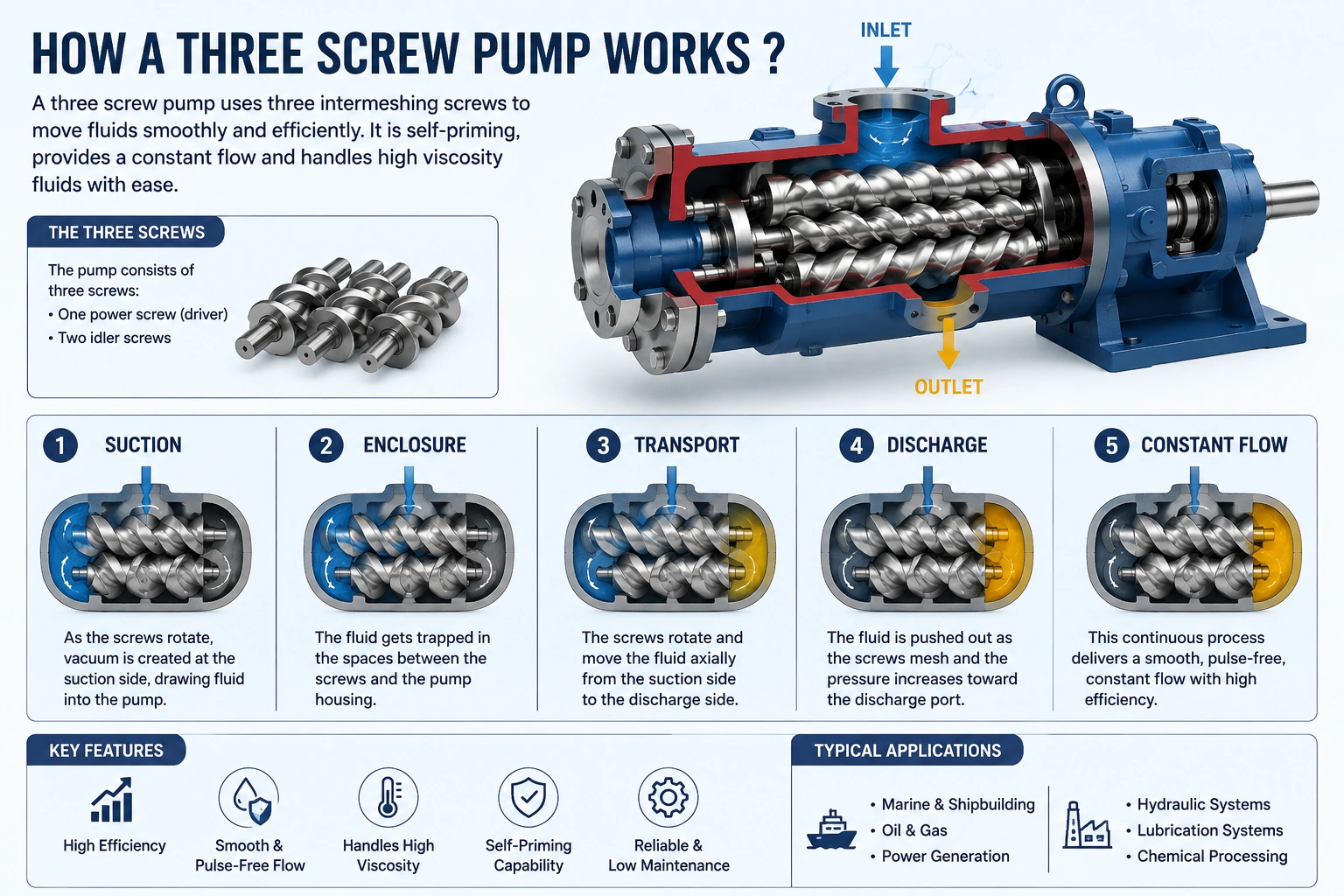
A three screw pump is a positive displacement rotary pump built around a simple but highly reliable principle: one power rotor and two idler rotors, running together inside a precision-bored housing. Also called a triple screw pump, it has been a workhorse in power generation, marine, and petroleum industries for over five decades. Delta PD Pumps, in partnership with Settima Meccanica SRL of Italy, has manufactured and supplied three screw pumps in India since 1970.
This guide covers how three screw pumps work, what sets them apart from other screw pump designs, and where they perform best.
How a Three Screw Pump Works
A three screw pump uses just three screw elements: one power screw and two idler screws, all running in three precision-bored chambers within a single housing or liner. The screws are profiled so precisely that they form a liquid-tight seal along the thread, creating sealed pockets that trap and convey fluid smoothly from inlet to outlet.
A common misunderstanding is that the power rotor mechanically drives the two idlers. It doesn’t. Instead, hydraulic pressure acting on the screw flanks turns the idlers torquelessly, with almost no friction. The idlers roll over the root diameter, which reduces unit pressure, keeps the power rotor centred, and absorbs radial loads. A balance piston, machined directly into the power rotor, handles axial thrust.
Because the screws run in hydrodynamic balance on a film of the pumped liquid itself, three screw pumps need no additional bearings to support the rotating elements. The single ball bearing typically used exists only to position the rotor axially and protect the mechanical seal, not to carry the running load.
This design allows small rotor dimensions, which means the pump can run directly coupled to 3000 or 3600 RPM motors, and up to 10,000 RPM under special conditions, without the added cost or complexity of a gearbox.
Key Performance Figures
Delta-Settima three screw pumps (model range D3S/D3M/D3SI) handle a wide operating envelope:
- Speeds up to 2,900 RPM as standard, extending to 10,000 RPM under special execution
- Viscosities up to 50,000 cSt or higher
- Operating temperatures up to 250°C with special execution
- Continuous, pulsation-free operation, often running non-stop for decades on clean fluids without component replacement
This combination of high speed, high viscosity tolerance, and thermal resilience is difficult to match with other rotary pump designs.
Three Screw Pumps vs Twin Screw Pumps vs Single Screw Pumps
Choosing the right screw pump design depends on the fluid, the required flow smoothness, and maintenance priorities.
| Feature | Three Screw Pump | Twin Screw Pump | Single Screw Pump |
|---|---|---|---|
| Rotor configuration | 1 power screw + 2 idler screws | 2 meshing screws (timing gears) | 1 eccentric rotor in stator |
| Bearings required | Minimal (one for axial positioning) | Anti-friction bearings on both shafts | Varies by design |
| Flow characteristics | Smooth, low noise, virtually pulsation-free | Smooth, self-priming | Handles solids and viscous media |
| Typical speed range | Up to 2,900 RPM standard, 10,000 RPM special | Lower than three screw, higher torque | Lower speed, higher torque |
| Best suited for | Clean, lubricating fluids, high speed | Wide viscosity range, self-priming needs | Fluids with solids or high viscosity |
| Maintenance points | Very low, hydrodynamic self-lubrication | Two shaft seals, more maintenance points | Rotor/stator wear over time |
Three screw pumps are the preferred choice where fluid cleanliness allows it, since their hydrodynamic design delivers exceptionally low noise, low vibration, and long service life with minimal maintenance.
Industries and Applications
Three screw pumps were originally introduced in India in 1970 for power plant applications, and that industry remains a core market. Today, three screw pumps are widely used across:
Power generation plants, where they handle lubrication oil systems and fuel oil transfer with high reliability under continuous duty. Petroleum and petrochemical facilities, for crude oil transfer, fuel injection, and burner systems requiring smooth, pulsation-free flow. Marine applications, including fuel oil service, lubrication, and hydraulic systems on board ships. Machine tool and hydraulic systems, where high-pressure, low-noise operation is essential.
The design’s tolerance for high viscosity and high temperature also makes it suitable for heavy fuel oil and lubricating oil applications where other pump types struggle to maintain efficiency.
Why Three Screw Pumps Last So Long
The hydrodynamic operating principle is the main reason three screw pumps have a reputation for exceptional service life. Because the power rotor and idlers never actually touch, and because the screws run on a self-generated film of the pumped fluid, wear is dramatically reduced compared to designs relying on mechanical contact or external bearing support for the rotating elements.
Delta’s three screw pumps, built on Settima Meccanica’s European engineering since 1978, are supplied and commissioned with the modifications needed for Indian operating conditions, supporting both new installations and the replacement market for existing plant equipment.
Three screw pumps are widely used in the cement industry for-kiln burner fuel oil transfer, lubrication systems, and hydraulic applications, where reliable, pulsation-free fluid handling is essential.
Choosing the Right Three Screw Pump
Selecting the correct model depends on several factors: the viscosity of the fluid being pumped, the required flow rate and pressure, operating temperature, and available drive speed. Delta PD Pumps’ D3S, D3M, and D3SI models cover a range of capacities and configurations, allowing the pump to be matched precisely to the application rather than forcing a single design across unsuitable duties.
For plants replacing ageing screw pumps or specifying new installations, working with a manufacturer that understands both the original OEM specifications and local operating conditions reduces the risk of premature failure and unplanned downtime.