

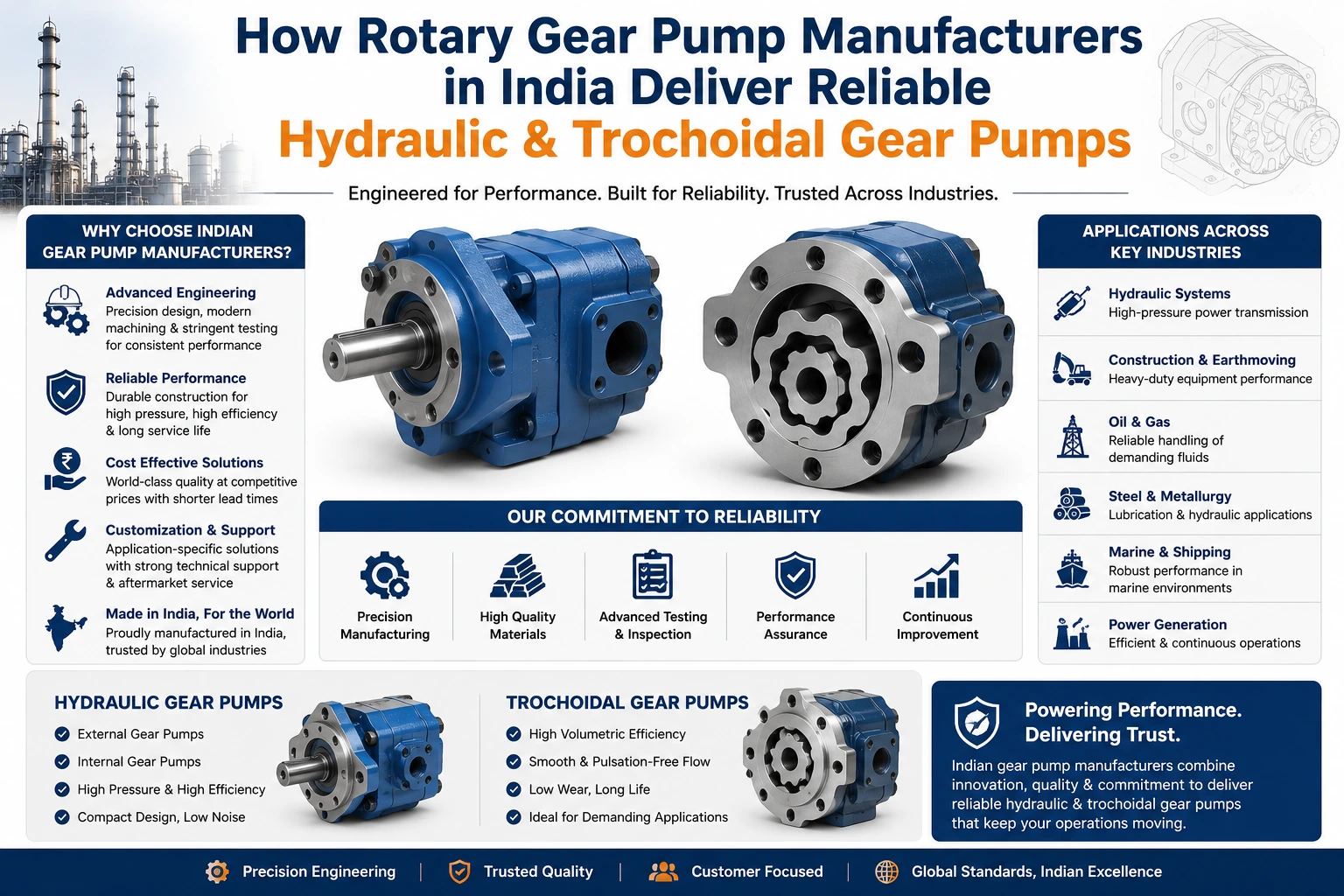
Gear pumps are one of the most reliable fluid transfer solutions in industrial settings. They are simple in design, rugged in build, and consistent in performance. Whether you work in oil refineries, hydraulic systems, chemical plants, or food processing, a gear pump is likely part of your operation.
India has developed a strong base of rotary gear pump manufacturers over the decades. With growing industrial demand and the push for locally engineered solutions, the market has expanded significantly. Companies like Delta PD Pumps have led this growth manufacturing precision-built pumps since 1968.
This guide covers everything you need to know how rotary gear pumps work, what makes the trochoidal design different, how to evaluate manufacturers, and which hydraulic pump types suit your application.
Key Takeaways
- A rotary gear pump moves fluid through the meshing of two or more gears, creating positive displacement.
- The rotary trochoidal gear pump uses an inner rotor and outer ring with a unique tooth profile, giving it smooth, near-pulsation-free flow.
- The three main types of hydraulic pumps are gear pumps, piston pumps, and vane pumps.
- Gear pumps are the most common hydraulic pump type due to their simplicity, durability, and low cost.
- India has several capable hydraulic gear pump manufacturers offering both standard and custom solutions.
- Delta PD Pumps, based in Mumbai, is one of India’s established rotary gear pump manufacturers with over 55 years of experience.
- Choosing the right manufacturer depends on pressure rating, viscosity compatibility, certifications, and after-sales support.
What Is a Rotary Gear Pump?
A rotary gear pump is a positive displacement pump. It moves fluid by trapping it between rotating gear teeth and the pump casing. As the gears turn, they unmesh on the inlet side, creating a low-pressure zone that draws fluid in. The fluid travels around the outside of the gears and is pushed out at the discharge side as the gears remesh.
This mechanism delivers a fixed volume of fluid per revolution. Flow is steady and predictable. That makes rotary gear pumps well-suited for applications that need consistent delivery lubrication systems, hydraulic circuits, fuel transfer, and chemical dosing.
There are two main configurations: external gear pumps and internal gear pumps. Both fall under the broader category of rotary positive displacement pumps.
What Is a Rotary Trochoidal Gear Pump?
The rotary trochoidal gear pump is a type of internal gear pump. It uses a trochoidal (or gerotor) tooth profile. An inner rotor sits inside a larger outer ring. The inner rotor has one fewer tooth than the outer ring. As both rotate together, the spaces between the teeth expand and contract, drawing in and pushing out fluid.
This design offers several advantages:
- Smooth, low-pulsation flow
- Compact footprint
- Fewer moving parts than external gear pumps
- Quiet operation
- Handles medium-viscosity fluids well
The Rotary Trochoidal Gear Pump from Delta PD Pumps is built for demanding industrial applications where consistent flow and minimal vibration matter. It is used widely in lubrication, oil transfer, and hydraulic service.
Rotary Gear Pump vs Other Pump Types: A Comparison
| Feature | Rotary Gear Pump | Piston Pump | Vane Pump | Centrifugal Pump |
|---|---|---|---|---|
| Flow type | Positive displacement | Positive displacement | Positive displacement | Dynamic |
| Pulsation | Low to moderate | Higher | Low | Very low |
| Pressure range | Up to 350 bar (gear), higher for piston | Up to 700+ bar | Up to 175 bar | Low pressure |
| Fluid viscosity | Low to high | Low to medium | Low to medium | Low |
| Self-priming | Yes | Yes | Yes | No |
| Cost | Low to medium | High | Medium | Low |
| Maintenance | Simple | Complex | Moderate | Simple |
| Common application | Hydraulics, lubrication, oil transfer | High-pressure hydraulics | Mobile hydraulics | Water, coolants |
| Ideal for India’s industry | Widely used across sectors | Heavy machinery, presses | Automotive, mobile | Water supply, HVAC |
This table shows that rotary gear pumps offer the best combination of versatility, cost, and ease of maintenance for most industrial fluid-handling tasks.
Types of Hydraulic Pumps
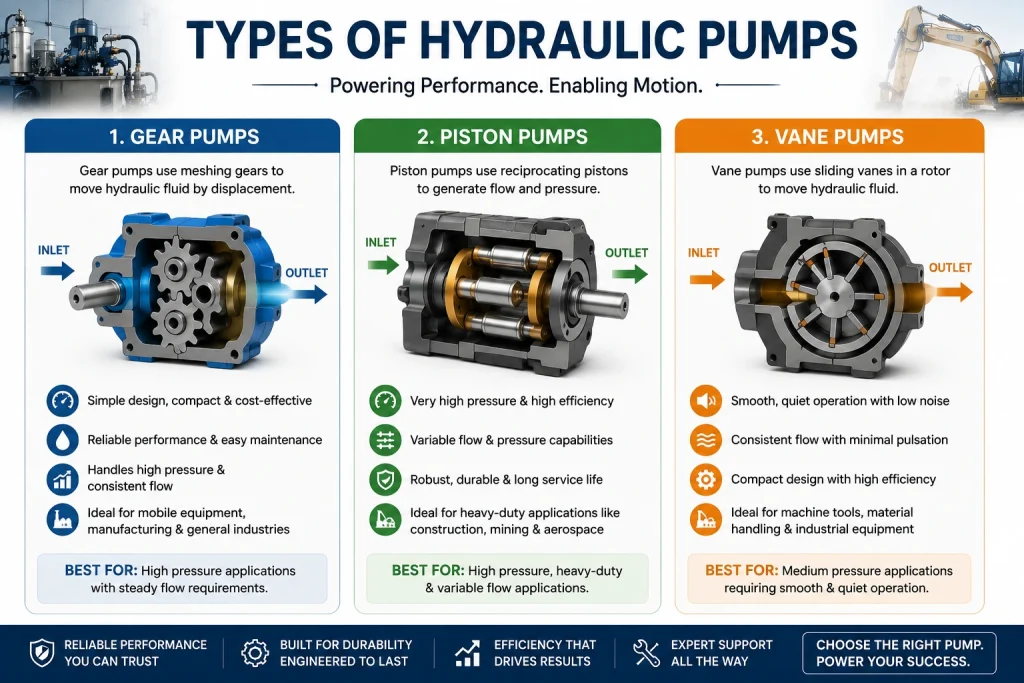
Three main types of hydraulic pumps are used in industry:
1. Gear Pumps
The most common type. Simple, durable, and cost-effective. Includes external gear and internal gear (trochoidal) designs. Works well with oil-based fluids and moderate viscosity applications. Available from most hydraulic gear pump manufacturers in India.
2. Piston Pumps
Used for high-pressure hydraulic systems. Can be axial or radial in design. More complex and expensive than gear pumps. Used in heavy machinery, press systems, and aerospace.
3. Vane Pumps
Use sliding vanes inside a rotor cavity. Quiet and smooth. Common in automotive and mobile hydraulics. Less suitable for high-viscosity or abrasive fluids.
Among these, gear pumps dominate the market in India because they handle a wide range of fluids, need minimal maintenance, and are easy to source and repair locally.
Why Gear Pumps Are the Most Common Hydraulic Pump
Gear pumps are the most common hydraulic pump type for good reason. They have very few moving parts. They are self-priming. They handle viscous fluids without issue. And they cost significantly less than piston pumps.
For most industrial and commercial hydraulic systems machine tools, injection moulding, power presses, steering systems a gear pump delivers reliable performance at a fraction of the cost of alternatives. That is why every major rotary gear pump manufacturer in India produces them in large volumes and across a wide range of sizes.
What Is a 3-Stage Hydraulic Pump?
A 3-stage hydraulic pump combines three pumping elements typically in a tandem or multi-section configuration within a single unit. Each stage operates at a different pressure or flow rate. This allows the system to deliver high flow at low pressure and lower flow at high pressure, switching automatically based on demand.
Three-stage pumps are common in log splitters, dump trucks, and hydraulic presses where rapid approach at low pressure and high-force clamping at high pressure are needed. They improve efficiency by matching pump output to actual system requirements.
The 7 Rules of Hydraulics
Understanding hydraulic principles helps you choose the right pump and system design. Here are the seven foundational rules:
- Pascal’s Law — Pressure applied to a confined fluid transmits equally in all directions.
- Flow determines speed — The speed of a hydraulic actuator depends on the volume of fluid entering it.
- Pressure determines force — The force output of a cylinder depends on pressure, not flow rate.
- Fluid takes the path of least resistance — Always design for controlled flow paths with appropriate valving.
- Heat is a sign of inefficiency — Excess heat means energy loss. Monitor fluid temperature.
- Contamination is the biggest cause of failure — Use clean fluid and maintain filters. Most hydraulic failures trace back to contamination.
- Positive displacement pumps produce flow, not pressure — Pressure is a result of resistance in the circuit, not something the pump creates on its own.
These rules guide how hydraulic systems are designed, operated, and maintained. Every competent hydraulic gear pump manufacturer in India designs products around these principles.
Two Basic Types of Hydraulics
Hydraulics is broadly divided into two categories:
1. Hydrodynamic (or Fluid Dynamics)
Uses the kinetic energy of moving fluid to transmit power. The most common example is the torque converter in an automatic gearbox. Flow velocity is key here.
2. Hydrostatic (or Fluid Statics)
Uses pressurised, confined fluid to transmit force and motion. This is what most people mean when they say “hydraulics.” Positive displacement pumps including rotary gear pumps are at the core of hydrostatic systems. Pressure is the key variable.
Most industrial and mobile hydraulic systems are hydrostatic. That is why positive displacement pumps from rotary gear pump manufacturers in India are in such high demand.
What to Look for in a Rotary Gear Pump Manufacturer in India
Not all manufacturers are equal. Here is what to evaluate before choosing a supplier:
Pressure and flow ratings — Confirm the pump covers your required operating range. Oversizing wastes energy. Undersizing causes failure.
Material compatibility — The pump body, gears, and seals must be compatible with your fluid whether that is hydraulic oil, fuel, chemicals, or food-grade liquids.
ISO certifications — An ISO 9001-certified manufacturer follows documented quality processes. Delta PD Pumps is an ISO 9001-certified company.
Application experience — Ask for references or case studies in your industry.
Spare parts and service support — This is critical for long-term reliability. A pump without local service support is a liability.
Lead times and stock availability — For large facilities, the ability to get spares quickly matters as much as the pump’s initial quality.
Delta PD Pumps has been manufacturing pumps in Mumbai since 1968. The company offers a wide range including the Rotary Trochoidal Gear Pump, External Gear Pumps, and Internal Gear Pumps with strong after-sales infrastructure across India.
Industries That Use Rotary Gear Pumps in India
Rotary gear pumps are used across a broad range of sectors in India:
- Oil & Gas — Crude transfer, lube oil systems, fuel injection
- Steel & Metals — Hydraulic press systems, rolling mill lubrication
- Chemicals & Pharmaceuticals — Dosing, transfer of medium-viscosity fluids
- Food & Beverages — Edible oil transfer (with food-grade materials)
- Marine — Fuel oil systems, bilge and lube oil handling
- Power Plants — Turbine lubrication, cooling oil systems
- Automotive — Hydraulic test rigs, assembly line presses
This cross-industry demand is why hydraulic gear pump manufacturers in India continue to grow their product ranges and manufacturing capacity.