


Gear pumps move fluid through rotating gears. They are simple, reliable, and widely used in industry. This guide explains how an external gear pump works, how it compares to an internal gear pump, and where each type fits best.
What Is a Gear Pump?
A gear pump is a type of positive displacement pump. It uses the meshing of gears to move fluid. As the gears rotate, they trap fluid between the gear teeth and the pump housing. The fluid then moves from the inlet to the outlet.
Gear pumps work well with viscous fluids. They deliver a steady, pulsation-free flow. You will find them in hydraulic systems, lubrication lines, and fuel supply circuits.
There are two main types: the external gear pump and the internal gear pump. Both use gear rotation to move fluid. But their design and performance differ in important ways.
External Gear Pump: How It Works
An external gear pump uses two identical gears that mesh on the outside. One gear is the drive gear. The other is the driven gear. They rotate in opposite directions.
Step-by-step working principle
-
Suction sideThe gears unmesh at the inlet. This creates a low-pressure zone. Fluid enters the pump housing and fills the space between the gear teeth.
-
TransportThe rotating gears carry the fluid along the outer housing wall. The fluid moves from inlet to outlet in the gaps between gear teeth.
-
Discharge sideThe gears re-mesh at the outlet. This squeezes the fluid out at high pressure. The fluid cannot go back because the meshing gears block the return path.
-
Continuous flowThis cycle repeats with every rotation. The result is a smooth and continuous flow of fluid.
 Key characteristic
An external gear pump generates high pressure with relatively low pulsation. It handles a wide range of viscosities and holds tight tolerances between gears and the pump housing.
External gear oil pump
A common application is the external gear oil pump. You find these in engine lubrication systems and hydraulic power units. The pump moves oil from a sump or tank and delivers it to bearings, valves, and actuators.
External gear oil pumps are compact and easy to maintain. They run reliably at high pressure. Most designs use spur gears, but some use helical gears to reduce noise.
Internal Gear Pump: Working Principle
An internal gear pump works differently. It uses two gears of different sizes. One gear sits inside the other. This is why it is called an internal gear pump.
The two key parts
The outer gear is the ring gear. It has teeth on its inner surface. The inner gear is the rotor. It has fewer teeth and sits off-centre inside the ring gear. A crescent-shaped divider separates the inlet and outlet zones.
How it moves fluid
The rotor turns inside the ring gear. Because the rotor has fewer teeth, it rotates faster than the ring gear. As both gears turn together, the teeth unmesh on one side. This creates a low-pressure area and draws fluid in.
The fluid fills the space between the teeth. It travels around the crescent divider. On the other side, the teeth re-mesh. This shrinks the fluid space and pushes the fluid out through the outlet port.
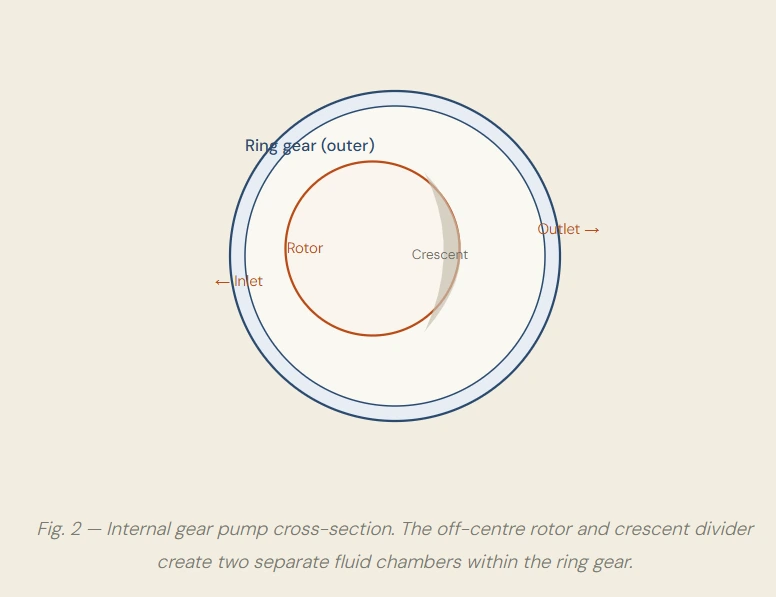
Why it mattersThe internal gear pump has fewer moving parts than an external gear pump. Both gears rotate in the same direction. This reduces vibration and noise. It also makes the pump suitable for thin fluids and shear-sensitive materials.
External vs Internal Gear Pump: Key Differences
Both pump types share the same core principle. But they perform differently in practice. The table below shows the main differences.
| Feature | External Gear Pump | Internal Gear Pump |
|---|---|---|
| Gear arrangement | Two external meshing gears | Rotor inside ring gear |
| Rotation direction | Opposite directions | Same direction |
| Pressure range | Up to 300 bar+ | Up to 200 bar |
| Flow smoothness | Good, slight pulsation | Very smooth, low pulsation |
| Noise level | Moderate | Low |
| Viscosity range | Medium to high | Low to high |
| Efficiency at low speed | Moderate | High |
| Size & weight | Compact | Slightly larger |
| Cost | Lower | Higher |
| Maintenance | Simple | Moderate |
The right gear pump depends on your pressure needs, fluid type, and noise requirements — not on one being universally better than the other
Where Gear Pumps Are Used
Gear pumps appear in many industries. Their simplicity and reliability make them a top choice for fluid transfer and pressure generation.
Hydraulics
Power steering, excavators, and industrial presses rely on external gear pumps for high-pressure fluid supply.
Engine lubrication
External gear oil pumps circulate engine oil to bearings and camshafts in petrol and diesel engines.
Chemical transfer
Internal gear pumps handle resins, adhesives, and polymers where smooth, gentle flow matters.
Fuel systems
Both types appear in fuel injection systems, burner supply lines, and fuel transfer stations.
Food & beverage
Internal gear pumps move syrups, oils, and chocolate without damaging the product.
Printing & coatings
Precision metering of inks and coatings demands the consistent output that internal gear pumps provide.
How to Choose the Right Gear Pump
Choosing between an external gear pump and an internal gear pump comes down to four factors.
1. Pressure requirements
If you need very high pressure, choose an external gear pump. It handles pressures above 250 bar in many standard designs. An internal gear pump suits medium-pressure applications up to around 200 bar.
2. Fluid viscosity
Both types handle viscous fluids well. However, internal gear pumps perform better with thin or low-viscosity fluids. They maintain efficiency across a wider viscosity range.
3. Noise and vibration
Internal gear pumps run more quietly. If noise is a concern — in medical, food, or office environments — choose an internal design. For industrial settings where noise is less critical, an external gear pump is a cost-effective choice.
4. Budget and maintenance
External gear pumps cost less and are easier to service. You can find standard replacement parts widely. Internal gear pumps cost more upfront but offer longer service life in demanding applications.
Quick decision guideNeed high pressure at low cost? Choose an external gear pump. Need quiet operation, low pulsation, or wide viscosity range? Choose an internal gear pump.
Maintenance Tips for Gear Pumps
Gear pumps are reliable. But they need regular care to stay that way. Follow these basic steps to extend pump life.
-
Check clearances regularlyThe gap between the gears and housing affects efficiency. Worn clearances reduce output pressure and flow. Measure them at every service interval.
-
Monitor fluid conditionDirty or degraded fluid damages gear surfaces and seals. Change fluid according to the manufacturer’s schedule. Use filters to protect the pump from particles.
-
Inspect seals and bearingsShaft seals prevent leaks. Bearings support the gear shafts. Replace both at the first sign of wear. A leaking seal can cause contamination and shaft damage.
-
Avoid running dryRunning a gear pump without fluid causes rapid wear. Always prime the pump before start-up. Install a low-level switch on the fluid reservoir for protection.
-
Control operating temperatureExcessive heat thins the fluid and reduces the lubrication film. Keep the fluid temperature within the pump’s rated range. Use a cooler if needed.
Conclusion
Gear pumps are a core technology in fluid systems. The external gear pump delivers high pressure and suits oil and hydraulic applications. The internal gear pump offers smooth flow, low noise, and wide viscosity handling. Both are positive displacement designs that rely on the same basic principle: rotating gears trap and move fluid.
Choose an external gear pump when pressure and cost matter most. Choose an internal gear pump when quiet operation, smooth flow, or low-speed performance is the priority. In both cases, regular maintenance keeps the pump running at full performance.
Understanding how each type works helps you make better decisions whether you are selecting a new pump, troubleshooting an existing system, or specifying a replacement including demanding environments like the cement industry, where reliable fluid handling directly affects equipment uptime.